A student receives their test paper back. At the top, a red '7/10' stares back at them. What does this number tell them? That they got something wrong, certainly. But what exactly? Which concepts did they misunderstand? How can they improve? The number is silent on all of these questions.
The Research on Feedback
Decades of educational research have consistently shown that specific, actionable feedback is one of the most powerful drivers of learning. Studies by educational psychologists like John Hattie have found that feedback has an effect size of 0.79—nearly double the impact of most other educational interventions.
However, not all feedback is created equal. Generic comments like 'Good work' or 'Needs improvement' have minimal impact. What students need is specific, timely feedback that tells them exactly what they did wrong, why it was wrong, and how to fix it.
The Challenge of Scale
The problem is obvious: providing personalized feedback to 40+ students is time-prohibitive. A teacher who spends just 5 minutes providing detailed feedback to each student would need over 3 hours per assessment. Multiply this by weekly assessments, and the math becomes impossible.
This is why most teachers resort to numerical grades with brief comments. It's not that they don't want to provide better feedback—it's that they simply don't have the time.
How AI Changes the Equation
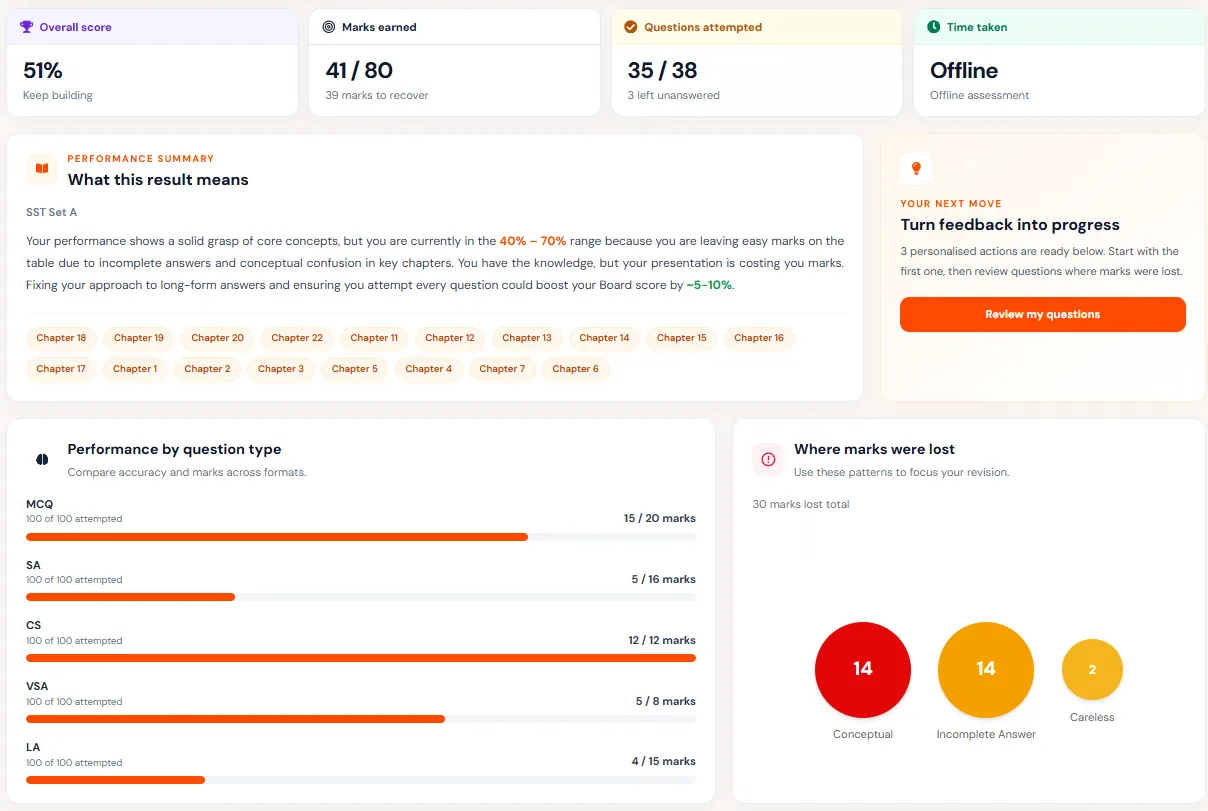
Artificial intelligence can provide detailed, personalized feedback at scale. For every answer, AI can identify specific mistakes, explain why the answer was incorrect, and suggest how to improve. This isn't generic feedback—it's tailored to each student's specific response.
For example, if a student incorrectly solves a quadratic equation, AI can identify whether the error was in factorization, application of the formula, or algebraic manipulation. The feedback can then address the specific misconception, not just mark the answer as wrong.
The Components of Effective Feedback
Research identifies three key components of effective feedback:
1. Task-focused: Feedback should address what the student did, not who they are. 'Your calculation error occurred in step 3' is more helpful than 'You're not good at math.'
2. Process-oriented: The best feedback explains the process or reasoning, not just the outcome. 'You forgot to consider the negative root' helps students understand the method, not just that they got it wrong.
3. Actionable: Feedback must suggest specific next steps. 'Review the quadratic formula and practice with similar problems' gives students a clear path forward.
AI can deliver all three components consistently, for every student, on every assessment.
Real-World Impact
Schools using AI-powered feedback report significant improvements in student learning. Students receive feedback within hours, not weeks. They understand their mistakes immediately, when the context is still fresh. And teachers can see patterns in student errors, allowing them to address common misconceptions in class.
Perhaps most importantly, students report feeling more confident. When they understand exactly what went wrong and how to fix it, learning becomes less intimidating. Mistakes transform from failures into learning opportunities.
The Future: Feedback as a Learning Tool
As AI feedback systems become more sophisticated, we're moving toward a model where assessment and learning are seamlessly integrated. Students don't just receive feedback—they receive personalized practice questions targeting their weak areas, explanations tailored to their learning style, and progress tracking that shows their improvement over time.
The goal isn't to replace teachers in the feedback process. It's to ensure that every student receives the kind of detailed, personalized guidance that was previously only available to those with private tutors. When AI handles the routine feedback, teachers can focus on the deeper conversations, the motivational support, and the human connection that truly transforms learning.