Introduction
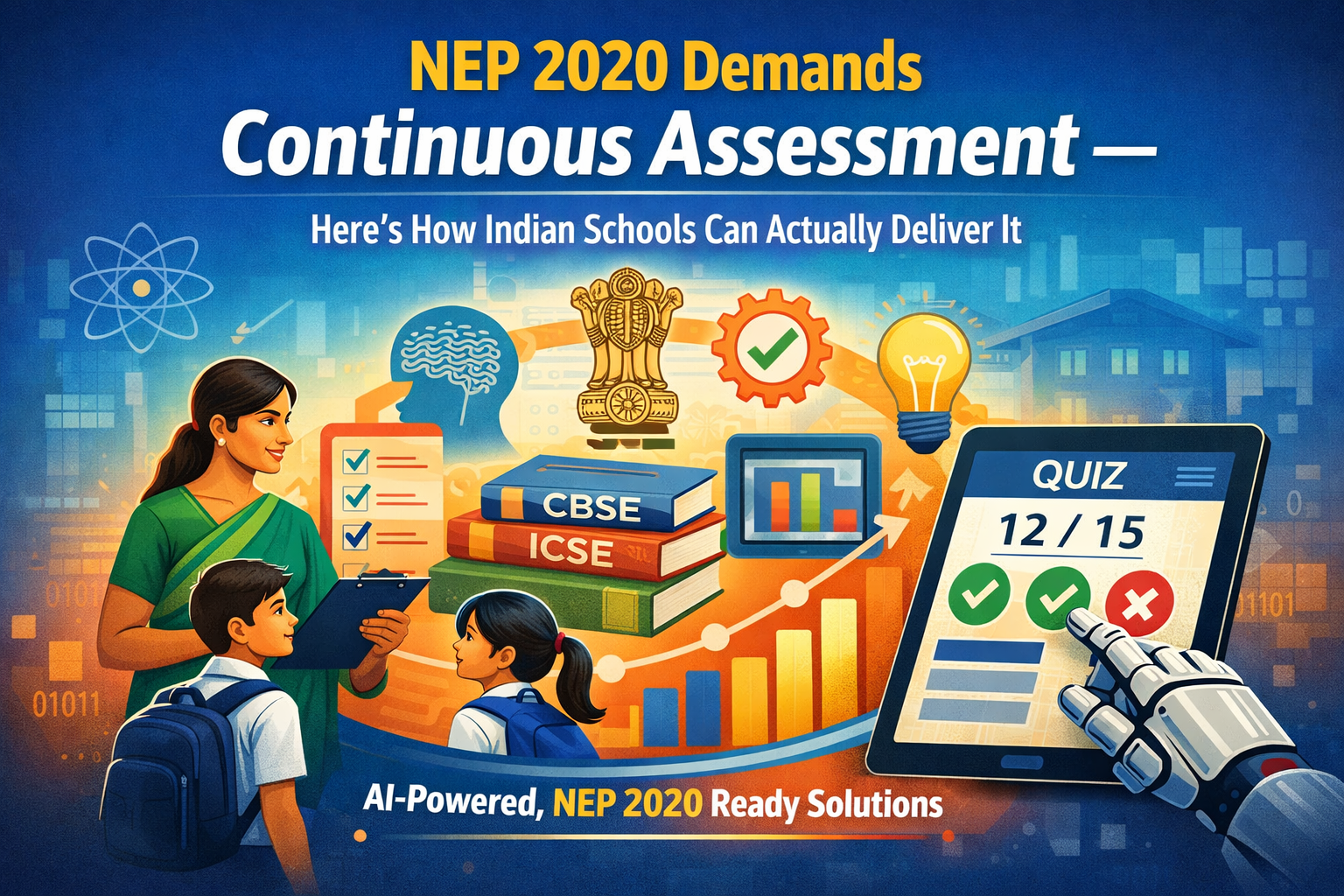
India's most ambitious education reform in decades is here — and it demands something most schools are woefully unprepared for: frequent, low-stakes, competency-based assessment for every single student. Here's the honest picture, and how AI is filling the gap.
The NEP 2020 Assessment Mandate — What It Actually Says
When the National Education Policy 2020 was unveiled, much of the conversation centred on structural changes: the 5+3+3+4 curriculum framework, mother tongue instruction in early years, multidisciplinary higher education. But buried in its chapters — and now central to every school board's compliance agenda — is a quiet revolution in how students are evaluated.
NEP 2020 explicitly calls for a shift away from rote-based, high-stakes annual examinations toward Competency-Based Assessment (CBA). The policy envisions assessments that are continuous and regular, tracking student progress throughout the year rather than only at year-end. They must be formative, not merely summative — designed to guide learning, not just grade it. They should be low-stakes and low-anxiety, relying on frequent short quizzes rather than one terrifying annual paper. They must be competency-mapped, aligned to specific learning outcomes rather than syllabus page numbers. And they should be holistic, encompassing cognitive, social-emotional, and creative domains together.
CBSE has moved quickly to operationalise this vision. Its Competency-Based Education (CBE) framework now requires that a significant percentage of board exam questions assess applied skills — not recall. As of recent cycles, 50% of Class 10 and 12 board questions are competency-based. ICSE has followed with its own progressive assessment frameworks. For school principals and academic leaders, the message is unmistakable: the era of the once-a-year exam as the primary measure of learning is over.
The Gap Between Policy and Classroom Reality
Here is the uncomfortable truth that every experienced educator already knows: the mandate is sound, but the execution is a crisis waiting to happen — at least without the right tools.
Consider what continuous assessment actually means at scale. A single teacher managing 40 students across three sections needs to design frequent, varied assessments, administer them without eating into precious teaching time, grade them accurately and quickly, convert raw scores into competency-level insights, share personalised feedback with each student, and track progress over months to identify learning trends. All of this, every week, on top of lesson planning, parent communication, and administrative duties.
The policy is visionary. But asking a teacher with 120 students to run personalised continuous assessments every week — without any infrastructure support — is not a reform. It is an unfunded mandate.
The result? Many schools are using the language of NEP 2020 compliance while continuing largely unchanged practices — periodic tests relabelled as "formative assessments," or digital worksheets dressed up as competency tracking. The policy intent is lost in translation.
What Genuine NEP-Aligned Assessment Actually Looks Like
Before discussing solutions, it is worth being specific about what best practice requires — because the bar is higher than most schools realise.
Competency-Based Question Design
NEP-aligned questions do not ask "What is photosynthesis?" — they ask "A plant is placed in a dark room for 48 hours. What will happen to its starch content and why?" The difference is profound. Designing even 20 such questions per week per subject, mapped to specific competencies, is genuinely skilled and time-consuming work.
Frequency Without Fatigue
The policy's vision of low-stakes frequent testing only works if assessments are genuinely low-effort — five-minute exit tickets, quick concept checks, short scenario-based problems. The moment these feel like mini-exams, student anxiety returns and the formative purpose is defeated.
Actionable Data, Not Just Scores
A percentage score tells a student and teacher almost nothing useful. NEP-aligned assessment reporting should identify which specific competencies a student has mastered, which are developing, and which need urgent intervention — with enough granularity to inform immediate next steps.
Board Compliance Documentation
CBSE's Holistic Progress Card and ICSE's equivalent require structured, timestamped evidence of continuous learning. Schools need audit trails, not just class averages, to meet board inspection standards.
How AI Makes Continuous Assessment Feasible
The honest answer to "how can Indian schools actually deliver NEP-mandated continuous assessment?" is: not without technology — and specifically, not without AI-powered assessment tools.
AI addresses every bottleneck in the chain. It can generate competency-mapped, Bloom's taxonomy-aligned questions in seconds, across subjects, grades, and difficulty levels, slashing teacher preparation time from hours to minutes. It automatically maps every student response to specific NEP learning outcomes, generating real-time competency heatmaps for individuals and entire classes. It enables low-stakes daily or weekly assessments to be deployed at scale without adding to teacher workload. And it produces compliance-ready progress reports structured to CBSE and ICSE frameworks — ready for board submission, parent communication, and internal review.
The schools that will genuinely deliver on NEP's assessment promise are the ones investing now in AI-powered infrastructure that makes continuous assessment easy, not heroic.
Chanakya AI — Built for NEP 2020 from the Ground Up
Among the tools emerging in India's EdTech landscape to address this challenge, Chanakya AI stands out as purpose-built for the Indian school context. Unlike generic quiz platforms or Western assessment tools retrofitted for Indian curricula, Chanakya AI has been designed with NEP 2020's continuous assessment mandate at its core.
Visit: https://aichanakya.in/
Here is how Chanakya AI maps directly onto every pillar of NEP-compliant assessment:
Competency-based question generation. The platform generates Bloom's-mapped, application-level questions automatically — aligned to the specific learning outcomes prescribed by CBSE and ICSE, not broad subject categories. A Class 8 science teacher does not need to configure anything; the system already knows which competencies map to force and motion.
Continuous assessment at scale. Daily and weekly low-stakes quiz formats can be deployed in under two minutes. Teachers are no longer designing from scratch every week — they are reviewing and approving AI-generated assessments, then spending their time on teaching.
Real-time competency dashboards. Every student response is instantly mapped to a specific competency, generating granular data on what each learner has mastered, what is developing, and where intervention is needed — surfaced clearly without requiring teachers to analyse raw score data themselves.
CBSE and ICSE compliance, built in. Chanakya AI produces structured progress reports aligned to CBSE's Holistic Progress Card requirements and ICSE's continuous assessment framework. Board-required documentation is generated automatically from ongoing assessment data — no separate data entry, no end-of-term scramble.
Zero additional teacher workload. Schools using Chanakya AI have reported implementing the full frequency of NEP-mandated formative assessments without any increase in teacher working hours. In several cases, teachers reported having more time for actual teaching after shifting assessment administration and reporting to the platform.
Chanakya AI is not a generic EdTech tool with an NEP label attached. It is a system built from the ground up for the specific demands of Indian schools navigating competency-based reform — and it is ready to use today.
A Practical Roadmap for School Leaders
For principals and academic directors wondering where to begin, a phased approach works well:
Step 1 — Audit current practices. Map your existing assessment methods against NEP's competency-based benchmarks. Most schools find the gaps in two areas: formative frequency and the quality of competency mapping in question design.
Step 2 — Run a focused pilot. Introduce AI-assisted assessment in two or three subject-grade combinations. Measure teacher time saved and the quality of competency data generated before scaling.
Step 3 — Build teacher capability. The technology handles generation, grading, and reporting. But interpreting competency dashboards and translating them into pedagogical decisions is a human skill — one worth investing in through structured professional development.
Step 4 — Integrate with compliance workflows. Connect assessment data to the documentation your board requires, so that CBSE's Holistic Progress Card and ICSE equivalents are populated automatically as the year progresses.
Step 5 — Let data drive decisions. Use the competency insights generated at scale to make school-wide curriculum and intervention decisions — shifting from gut instinct to evidence-based academic leadership.
The Bottom Line
NEP 2020's vision of continuous, competency-based, low-stakes assessment is the right vision. The research is unambiguous: students who receive frequent, targeted formative feedback learn faster, retain more, and experience significantly less exam anxiety than those evaluated only at year-end.
But vision without infrastructure is wishful thinking. Indian schools — with overworked teachers, large classrooms, and stretched budgets — cannot implement this mandate through willpower alone.
The schools that will genuinely deliver on NEP's assessment promise are the ones acting now. The technology exists. The policy framework is in place. Tools like Chanakya AI make the full scope of continuous, competency-based assessment not just achievable but manageable.
The only question is whether your school will be among the early adopters who get ahead of compliance — or among those scrambling to catch up when board inspections and parent expectations make the gap impossible to ignore.
Ready to become an NEP 2020-compliant school? Start with Chanakya AI: https://aichanakya.in/