India is at a critical juncture in educational change. With the largest youth population in the world and an expanding digital ecosystem, the nation is particularly well-placed to harness artificial intelligence to bring quality education to its expansive and diverse terrain. This article discusses how AI solutions such as Chanakya AI are set to transform Indian classrooms in the coming decade, overcoming traditional challenges while opening up new opportunities for 370 million students.
The Present Scenario: Opportunities and Challenges
The Indian education system is confronted with a daunting set of challenges even after achieving a lot of improvement over the last few years:
Scale and Diversity: With 1.5 million schools, 10 million teachers, and students speaking more than 120 languages, providing uniform quality education is challenging.
Teacher-Student Ratio: The mean 1:35 teacher-student ratio in government schools makes one-to-one attention nearly impossible through conventional approaches.
Assessment Burden: Indian teachers spend around 30-40% of their professional time on assessment tasks, decreasing teaching potential.
Regional Disparities: Immense disparities in the quality of education and performance between urban and rural regions, as well as between states.
Examination Pressure: The high-stakes exam culture imposes monstrous pressure while leaning towards rote learning rather than comprehending concepts far too frequently.
But some factors provide fertile ground for AI integration:
Digital India Initiative: Government efforts towards digital infrastructure have driven internet penetration to 47% with growth expected to reach 75% by 2027.
NEP 2020: The New Education Policy actively promotes the use of technology in teaching, learning, and assessment.
Smartphone Penetration: More than 500 million smartphone users provide opportunities for educational technology to extend to remote locations.
EdTech Growth: India's education technology market grew to $2.8 billion in 2024 with expected annual growth of 39% through 2028.
Five Revolutionary AI Trends Redefining Indian Education
1. Personalized Adaptive Learning at Scale
AI-powered solutions like Chanakya AI are transforming personalization in Indian classrooms:
Learning Path Customization: Advanced algorithms correlate student skills and design personalized learning paths based on strengths, weaknesses, and rates of learning.
Multi-language Support: AI-driven translation and natural language processing make it possible to deliver content in local languages, overcoming significant language hurdles.
Accessibility Solutions: Future AI applications offer students with different abilities and needs other learning modes.
By 2027, we predict that 30% of Indian K-12 institutions will have an AI-driven customized learning system of some sort that will touch 100 million plus students.
2. Human-Like Evaluation with Mechanized Processes
Testing processes are being revolutionized by AI while preserving the essence of India's subjective test culture:
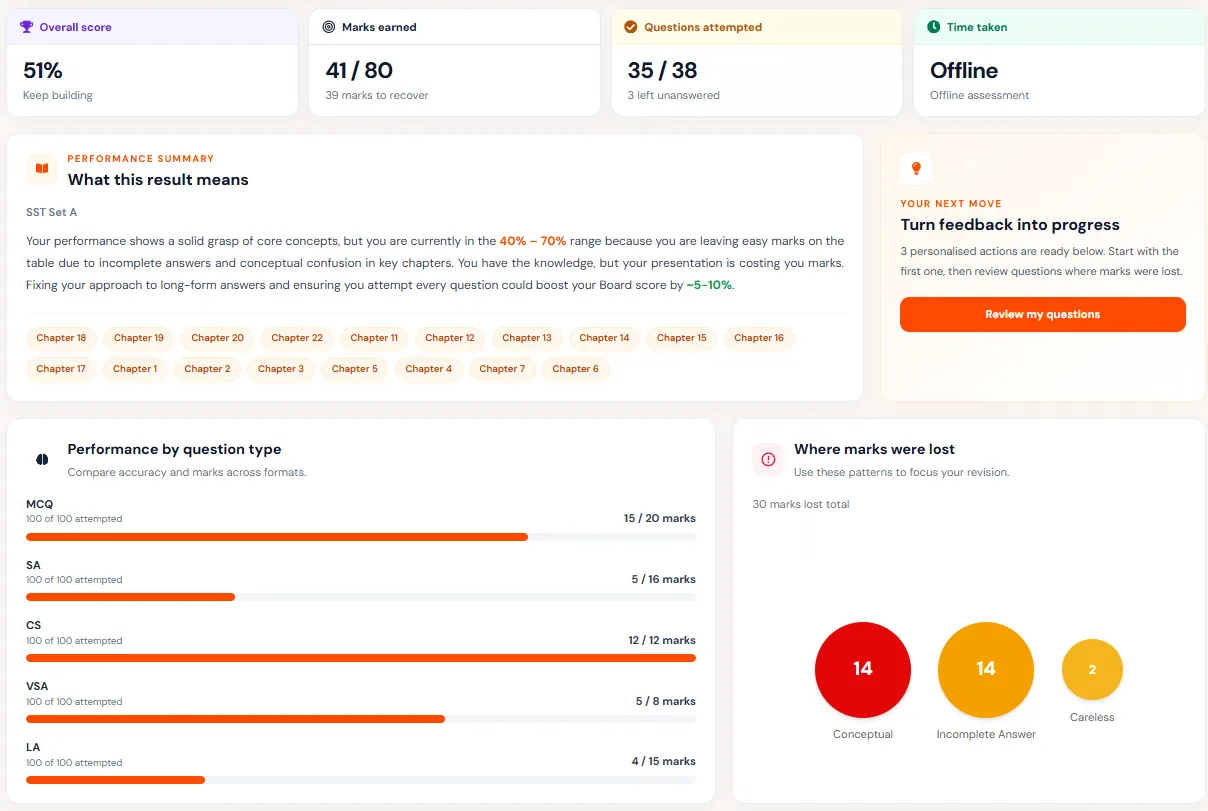
Subjective Answer Grading: Advanced language models can grade long answers with subtle comprehension of subject matter, saving teacher workload by as much as 70%.
Misconception Pattern Detection: AI analysis detects specific misconceptions and skill gaps in thousands of student answers.
Instant Feedback: Real-time detailed assessment feedback speeds up learning cycles, especially useful in high-enrollment courses.
Bias Elimination: Standard AI grading eliminates grading inconsistency while preserving human oversight.
3. Teacher Augmentation and Empowerment
Transcending fears of replacement, AI will enhance teacher impact:
Administrative Automation: Repetitive tasks such as attendance, simple grading, and record-keeping are more and more delegated to AI systems.
Teaching Assistants: AI agents offer real-time classroom insight, recommending interventions for struggling students and enrichment activities for high-potential students.
Personalized Professional Development: Teacher training programs are customized to respond to particular pedagogical needs, enabling instructors to learn new techniques.
Resource Creation: Content creation tools assist in creating customized worksheets, quizzes, and study guides according to curriculum requirements.
Studies show that AI-driven teachers in Indian schools can increase the effectiveness of teaching by up to two times by concentrating on higher-order teaching tasks.
4. Data-Driven Education Governance
AI analytics are transforming education administration and policy enforcement:
Predictive Analytics: Early warning systems detect struggling schools, districts, and student groups likely to underperform.
Resource Optimization: AI-driven algorithms help optimize scarce educational resources to achieve maximum impact across different geographies.
Policy Evaluation: High-speed feedback loops evaluate the success of educational interventions at record scale and speed.
Targeted Interventions: Data patterns inform targeted interventions for particular regional or demographic educational issues.
5. Formal and Informal Learning Stretching
AI is stretching the boundaries between home, school, and community learning:
24/7 Support for Learning: AI-driven tutor platforms offer after-class homework support and concept explanation in homes where parents are not educated.
Skill Building as Embedded: Academic concepts are linked through learning interfaces with vocational competence and real-world application.
Parental Involvement: Easy-to-understand analytics deliver guardians insightful details regarding children's performance and actionable means of contributing to learning.
Community Learning Networks: AI makes peer learning groups a possibility over distance, bringing together learners with similar interests or learning needs.
Implementation of AI: Challenges and Contemplations
Some key determinants will snap or forge the use of AI in Indian education:
Infrastructure Building
Physical requirements continue to pose a big issue:
Digital Divide: Urban-rural differences in connectivity and access to devices demand creative solutions such as low-bandwidth AI apps.
Power Needs: Power supply is spasmodic in most school environments, necessitating offline capability in AI.
Device Affordability: Affordable hardware solutions need to make learning AI accessible in a large majority.
Cultural Integration
Technology adoption demands that Indian education tradition be honored:
Teachers' Adaptation: Training needs to cover technical expertise as well as attitudinal change in teaching practice.
Family Empathy: Communication strategies will be required to foster trust in AI-driven learning within families.
Balance with Traditional Approaches: Effective implementation will balance technology with the much-appreciated elements of India's richly diverse educational culture.
Ethical and Privacy Concerns
Rigorous deployment of AI requires strong protections:
Data Protection: Open policies will have to guide the collection, storage, and application of student data.
Algorithmic Openness: Systems will need to be comprehensively tested so that they don't reinforce biases along region, language, gender, or economic lines.
Human Judgment: AI has to augment and not supplant human judgment in high-stakes decisions.
Transparency: Teachers, students, and parents have a right to unambiguous explanations about the working of AI systems and providing recommendations.
The Path Forward: A Balanced Approach
The most viable implementation plan blends vision with practical implementation:
Public-Private Collaboration
Effective AI education change demands collective action from government agencies setting standards and ensuring equitable access, educational institutions leading adoption, technology providers creating India-specific solutions, and research organizations tracking effectiveness.
Phased Implementation
Stepwise implementation guarantees long-term adoption through pilot programs in welcoming environments, evidence-based success demonstration prior to large-scale deployment, building local capacity for educational AI deployment, and adaptive expansion scaling up successful implementations with modifications to regional contexts.
Vision 2030: AI-Powered Indian Education
By the end of this decade, we foresee an Indian education system where every student is provided with customized learning experiences irrespective of location or background. Teachers are facilitators of learning with AI tools that take care of mundane tasks. Constructive, immediate feedback from assessment results in ongoing improvement. Evidence-based policy is informed by educational data at the state, national, and local levels. Learning automatically transfers from formal schooling via home and community settings. AI assists in preserving and transmitting India's cultural and linguistic heritage and prepares learners for global citizenship.
Conclusion: India's Educational AI Opportunity
It is not just a matter of adopting technology—implying the potential to achieve the constitutional vision of quality education for all. Used with caution in ways that honor cultural sensitivity, shield against infrastructure weakness, and give ethics the highest priority, AI has the potential to transcend long-standing obstacles while being true to India's strong pedagogical heritage.
The coming decade presents a historic opportunity to re-imagine learning for hundreds of millions of young Indians. By adopting AI tools such as Chanakya AI with wisdom and foresight, India can create a model of education that combines the best of human instruction and technology, which could serve as an example that other large, multicultural countries may wish to emulate.