Every teacher has seen it: a student who seemed fine in the first term suddenly struggles in the second, or a student who performed well on unit tests fails the final exam. What happened? In most cases, the warning signs were there—they just weren't noticed until it was too late.
The Cost of Late Detection
When learning gaps are identified only at exam time, intervention becomes crisis management. Students are already behind, stressed, and demotivated. Teachers scramble to provide remedial support, but there's limited time before the next assessment.
The result? Students continue to struggle, confidence erodes, and the gap widens. What started as a small misunderstanding in one topic becomes a pattern of failure across multiple subjects.
Early Warning Signs
Learning gaps don't appear suddenly—they develop gradually. The key is recognizing the early indicators:
Declining Performance Trends: A student whose scores are gradually decreasing, even if they're still passing, may be developing gaps. Look for patterns, not just individual scores.
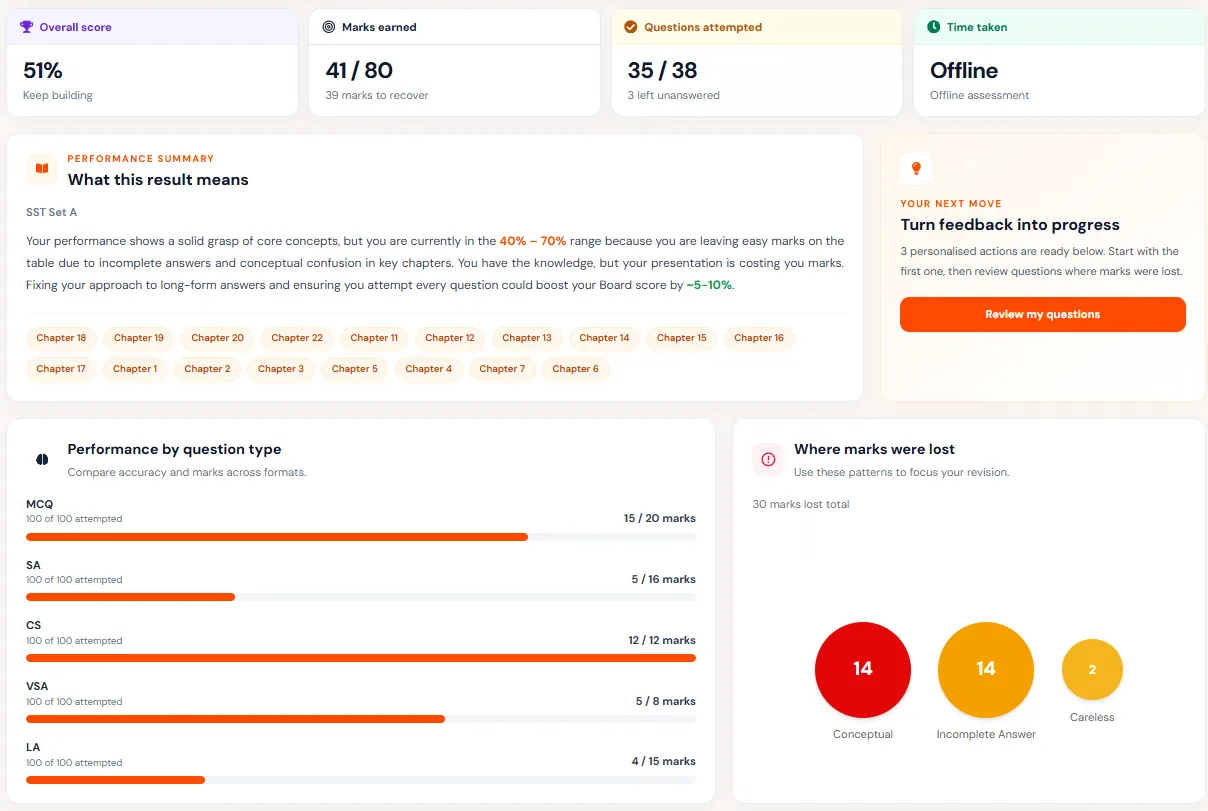
Incomplete Answers: Students who consistently leave questions blank or provide partial answers may be avoiding topics they don't understand.
Conceptual Confusion: Students who can solve routine problems but struggle with application questions may have surface-level understanding without deep comprehension.
Time Management Issues: Students who consistently run out of time may be spending too long on concepts they don't fully grasp.
Avoidance Behavior: Students who seem disengaged during certain topics may be avoiding subjects where they feel lost.
The Challenge of Detection
In a class of 40 students, identifying these patterns manually is nearly impossible. Teachers can see individual performance, but spotting trends across multiple assessments requires systematic tracking and analysis.
This is where technology becomes invaluable. AI-powered analytics can identify patterns that would be invisible to even the most observant teacher. Which students are showing declining trends? Which topics are causing widespread confusion? Which students need immediate intervention?
The Intervention Window
Research shows that early intervention is dramatically more effective than late remediation. When problems are caught early:
Students are more receptive: They haven't yet developed negative associations with the subject.
Gaps are smaller: Addressing a small misunderstanding is easier than rebuilding foundational knowledge.
Time is available: There's time for targeted practice and reinforcement before high-stakes assessments.
Confidence is preserved: Students maintain their sense of competence and motivation.
Building an Early Warning System
Effective early intervention requires three components:
1. Regular Assessment: Frequent, low-stakes assessments provide data points to track trends. Weekly worksheets are more valuable than monthly tests for early detection.
2. Systematic Tracking: Performance data must be collected and analyzed consistently. This is where digital tools excel—they can track trends automatically.
3. Actionable Alerts: Teachers need clear signals when intervention is needed. Automated alerts for declining performance or topic-specific struggles ensure nothing falls through the cracks.
Real-World Impact
Schools implementing early intervention systems report significant improvements. At one Delhi-NCR school, AI-powered analytics identified 15 students showing early warning signs in Mathematics. Targeted intervention over 4 weeks resulted in 12 of those students improving their performance by 20% or more.
The key wasn't just identifying the students—it was identifying them early enough to intervene effectively.
The Role of Technology
Modern assessment platforms can automatically track student performance, identify trends, and alert teachers to students who need attention. This doesn't replace teacher judgment—it enhances it by providing data-driven insights that inform decision-making.
When teachers can see which students are struggling with which topics, they can provide targeted support. When they can identify class-wide patterns, they can adjust their teaching. And when they can catch problems early, they can prevent crises before they develop.
A Proactive Approach to Student Success
The goal isn't to catch every student before they struggle—some challenges are part of the learning process. The goal is to ensure that when students do struggle, we notice early and intervene effectively.
Early intervention transforms assessment from a judgment tool into a diagnostic tool. Instead of discovering problems at exam time, we identify them during the learning process. Instead of crisis management, we provide proactive support. And instead of watching students fall behind, we help them stay ahead.